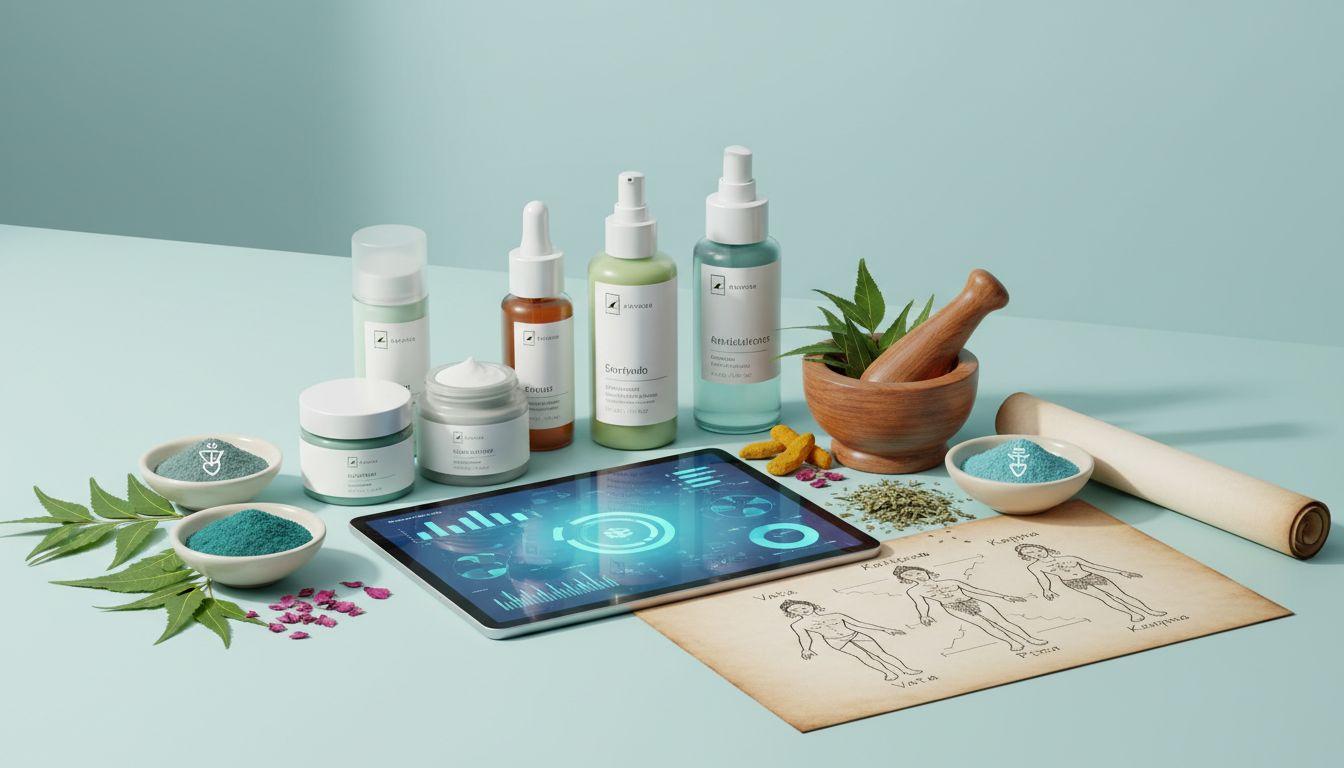
Ayurvedic beauty has always been personal. Long before skin quizzes, selfie diagnostics, and AI recommendation engines, the tradition looked at the individual first: prakriti, seasonal shifts, digestion, stress, sleep, and the subtle signs that show up on the skin and scalp. What is changing in 2025 is not the desire for personalization, but the tools being used to deliver it. Today, the language of dosha is increasingly meeting the language of data.
This shift is especially relevant for younger, urban consumers who want routines that feel both rooted and practical. They may still reach for neem, rose, bhringraj, turmeric, or kumkumadi-inspired care, but they also expect precision, convenience, and proof. Across beauty and wellness, brands are translating ancient herbal rituals into digital consultations, biomarker-led diagnostics, adaptive skincare routines, and custom formulations. In many ways, personalized beauty is becoming the bridge between heritage and high-tech care.
Why personalization is becoming the new beauty standard
The beauty industry is moving quickly away from one-size-fits-all products. McKinsey’s State of Beauty 2025 notes that sophisticated consumer insights and hyperpersonalization are now table stakes. It also points out that stronger AI use across research and development, quality control, social listening, and marketing personalization could become an important growth driver for brands. In simple terms, personalization is no longer a niche add-on. It is becoming the expected starting point.
The numbers support that trend. Grand View Research estimated the global beauty tech market at $66.16 billion in 2024 and projects it to reach $172.99 billion by 2030, growing at a 17.9% CAGR from 2025 to 2030. Personalized skincare is one of the major engines behind that growth. Separately, the global personalized skin care products market was estimated at $26.20 billion in 2022 and is projected to reach $48.65 billion by 2030. That tells us consumers are not just curious about customization; they are actively buying into it.
This matters for Ayurveda because personalization has always been one of its strongest ideas. Instead of forcing everyone into the same routine, Ayurvedic thinking asks what this person needs now. That philosophy fits surprisingly well with the direction of modern beauty-tech. The difference is that today’s brands are using apps, data models, and diagnostics to replicate what traditional systems tried to understand through observation, questioning, and lived routine.
From dosha logic to measurable signals
In Ayurveda, a beauty recommendation might begin with questions about dryness, oiliness, heat, sensitivity, scalp condition, sleep patterns, digestion, and stress. These are not random observations; they are part of a wider effort to understand imbalance. In modern beauty-tech, the same goal is increasingly approached through measurable signals such as hydration levels, barrier strength, pigmentation markers, microbiome patterns, skin physiology, and environmental exposure. The method is changing, but the intention remains personal care based on individual variation.
Research is making this connection more explicit. A 2025 arXiv dataset paper, Prakriti200, introduced a structured dataset of 200 Ayurvedic prakriti assessments for computational intelligence and personalized health analytics. That is a meaningful sign of where things are ed. Once traditional classifications are translated into datasets, they become easier to study, compare, model, and eventually integrate into digital tools.
Other 2025 research is pushing personalization even further toward biological inputs. A Korean cosmetics study developed a deep neural network recommendation model using skin physiological indicators from a skin genomics platform. At the same time, a PubMed-indexed review highlighted how AI-driven innovations can support dynamic, adaptive skincare routines that respond to physiological and environmental changes in real time. This is where personalized beauty becomes especially interesting: the routine is no longer fixed, but responsive.
How herbal rituals are being reimagined for digital lifestyles
Traditional beauty rituals are often built around repetition, seasonality, and sensory care. Think of weekly oiling, ubtan-like cleansing, flower waters, herbal masks, or scalp massage before washing. For many consumers today, the challenge is not interest but consistency. Urban life is fast, climate exposure is intense, and routines need to fit around work, commuting, and screen-heavy days. That is one reason heritage practices are being reframed as modern rituals rather than old-fashioned habits.
Croda Beauty’s 2025 trend materials describe “heritage beauty” and evolving rituals, reflecting how ingredient stories and routine-based care are being repackaged for contemporary consumers. The language is important. A ritual feels intentional, calming, and premium, while still sounding accessible. It allows brands to preserve the emotional and cultural richness of herbs, oils, and traditional sequences while making them easier to adopt through cleaner formats, simpler instructions, and digitally guided routines.
This reframing works well with Ayurveda because the tradition already values rhythm and context. A ritual is not only about what ingredient is applied, but when, how, and why. In a digital setting, that may look like an app reminding you to switch from a heavier oil-based routine in dry weather to a lighter, cooling botanical layer in humid months. The ritual survives, but its delivery becomes more practical and personalized beauty becomes easier to maintain.
Diagnostics, AI, and the rise of real-time recommendations
One of the clearest signs of modernization is the rise of diagnostic tools that turn skin information into recommendations. At CES 2025, L’Oréal introduced Cell BioPrint, a tabletop device that uses biomarkers to offer deeper skin analysis and guide beauty and longevity decisions. This kind of technology moves beyond surface-level guessing. It suggests a future where product choice is informed by measurable biological patterns, not just broad skin-type labels.
AI is also making routines more flexible. According to a 2025 review, AI-enabled systems can create dynamic, adaptive skincare routines that change in response to physiological and environmental shifts. That is useful in real life, where skin may behave differently during monsoon, high pollution days, exam stress, travel, sleep loss, or heavy sun exposure. Instead of one static routine, consumers can receive ongoing guidance that adjusts with circumstances.
The same trend is expanding beyond the face. In April 2025, Prose launched its Custom Scalp Serum, reinforcing the movement toward bespoke, data-informed hair and scalp care. For Ayurveda-minded consumers, this is a natural extension. Traditional systems have long linked scalp condition, hair texture, heat, dryness, and stress. Modern tools now offer brands a way to personalize these concerns with more precision and potentially better follow-through.
Why natural ingredients still matter in a high-tech beauty world
More technology does not mean consumers want fewer botanicals. In fact, the opposite may be true. NSF reported in March 2025 that 74% of consumers consider organic ingredients important in personal care, and that respondents are actively seeking clean-beauty products made with organic, toxin-free ingredients. This is a useful reminder that people do not just want precision. They also want familiarity, gentleness, and trust.
That is where herbal formats continue to hold strong appeal. A 2025 pharmacy journal review listed herbal cosmetics, herbal skin care, and herbal hair care as core themes, showing that plant-based beauty is still a live and relevant category. Ingredients such as aloe, amla, tulsi, sandalwood-inspired actives, manjistha, hibiscus, and licorice continue to resonate because they connect performance with a broader wellness story.
For brands, the smart move is not choosing between nature and technology. It is combining them thoughtfully. A personalized serum may still feature botanical actives. A scalp treatment may still be built around herb-based support. The modernization happens in the formulation logic, the diagnostic process, the delivery system, and the recommendation engine. In other words, herbs remain the emotional and functional anchor, while data improves the match.
Ayurveda’s digital turn: education, microbiome science, and analytics
Ayurveda is not standing outside the digital shift. A 2025 Frontiers article on Ayurveda education highlighted virtual patient case simulations, showing how traditional knowledge systems are being translated into digital and scalable formats. While this example is educational, it reflects a larger movement: ancient frameworks are being organized in ways that technology can process, teach, and apply more broadly.
Research is also linking Ayurvedic ideas with modern biological science. A 2025 study on Ayurvedic breathwork and skin microbiome dynamics described its work as integrating ancient Ayurvedic knowledge with contemporary microbiome science, pointing toward personalized and non-invasive strategies. This is a fascinating development because it expands the idea of beauty beyond topical application. It suggests that stress regulation, breathing, and internal balance may increasingly be studied through measurable skin-related outcomes.
At the level of formal discourse, this merger is becoming more visible too. A 2025 paper in the Journal of Ayurveda and Holistic Medicine was explicitly titled Incorporation of Traditional Wisdom in Cosmetology for Sustainable Beauty Care. That title alone captures the moment well. Ayurveda is no longer being discussed only as heritage or folklore; it is being positioned as a relevant part of sustainable, personalized, and modern beauty thinking.
What consumers now expect: education, trust, and transparency
Digital discovery has become central to beauty shopping. Grand View Research cites BeautyMatter’s 2024 Change Up Report, noting that about 70% of beauty consumers use digital platforms to discover and research products before buying. More than half say online education and expert recommendations influence skincare decisions. For Ayurvedic and herbal brands, this means product success depends not only on ingredients, but on how clearly the routine is explained.
Consumers also want reassurance that recommendations are credible. Akeneo’s 2025 B2C survey found that buyers increasingly value transparency, personalization, and authenticity. Nearly half of category buyers said they would probably or definitely buy beauty or skincare products if they saw an influencer or independent expert using them. This creates both an opportunity and a responsibility. Brands can use storytelling around rituals and herbs, but they also need evidence, clear instructions, and honest communication.
Behavioral data is already shaping this ecosystem. Revieve’s 2026 Beauty & Wellness Index 2025 says its findings are based on millions of anonymized AI-powered consumer interactions across skincare and makeup, including selfie diagnostics and virtual try-on. That means recommendation systems are not operating in theory alone. They are learning from real user behavior at scale. The challenge for heritage-led beauty is to use that intelligence without losing the nuance and humanity of traditional care.
Ancient rituals as tomorrow’s data products
Looking across these trends, one business takeaway stands out clearly: ancient rituals are increasingly becoming data products. The story of dosha, herbs, oils, and self-care sequences remains powerful, but the delivery is changing. Brands are modernizing through AI diagnostics, virtual consultations, biometrics, genomics, adaptive routines, and custom formulas. The ritual is still there, but it is being translated into recommendation flows, dashboards, subscription logic, and measurable outcomes.
This does not have to be a cynical shift. If done well, it can make traditional care more accessible and more relevant. Someone who would never read a classical Ayurvedic text may still complete a skin consultation, receive a personalized botanical routine, and understand why their dryness worsens in air-conditioned environments or why their scalp flares under stress. Data can become a practical language that helps consumers apply old wisdom in a modern context.
The most promising future is likely one that respects both systems. Ayurveda offers context, pattern recognition, and a holistic view of the person. Data offers scale, tracking, consistency, and feedback loops. When these are combined carefully, personalized beauty can move beyond trend language and become genuinely useful. That is where ancient herbal rituals may find their strongest new life: not as museum pieces, but as living routines shaped by insight.
For everyday users, the takeaway is simple. You do not need to choose between tradition and technology. You can value herbs, oils, and mindful rituals while also appreciating tools that help you understand your skin and scalp more clearly. The best routine is not the most expensive or the most complicated. It is the one that suits your , your environment, and your ability to stay consistent.
As the beauty world builds smarter ecosystems with AI, AR, diagnostics, and tailored recommendations, Ayurvedic ideas may become even more relevant, not less. After all, the heart of Ayurveda has always been personalization. The modern twist is that personalized beauty now has new instruments to express that truth, making ancient care feel timely, usable, and deeply aligned with the way people want to shop and live today.